3 January 1942
John Edward Thaw was born at his mother’s parents’ home in Longsight, an inner-city suburb of Manchester. He was the first child of John “Jack” Thaw and Dorothy “Dolly” Ablott, who had married only a year earlier when Jack was twenty-one and Dorothy was nineteen. Exempt from military service due to a childhood injury, Jack Thaw served during wartime as a volunteer rescue worker with the Fire Brigade and worked in a munitions factory and later in the mines. For the first few years of John’s childhood, the family lived in a small terraced house on Stowell Street in West Gorton, Manchester. Jack Thaw’s mother and father lived next door, and his sister Beattie and her husband Charlie also lived on the same street.
Stowell Street, which was located between the Longsight Railway sidings and Hyde Road, was demolished in 1983 to make way for new developments.

David Boardman’s fascinating website, ‘Longsight Memories’, part of Our Manchester, includes lots of information about the area where John grew up, including maps, and photos of the Belle Vue Gardens and Zoo that John enjoyed visiting as a child.
15 November 1944
Jack and Dorothy’s second child, Raymond “Ray” Stuart Thaw was born. John was just under three years old when his younger brother arrived.
1945 – 1953: Early Years
With the end of the war, Jack Thaw took a job as a long-distance lorry driver, meaning that his young wife was often left on her own. It seems that Dorothy found these absences and the responsibilities of her early marriage and motherhood difficult to cope with, and the marriage began to suffer.
During this unsettled time, the family moved in for a while with Dorothy’s parents, then to a council flat in Wythenshawe, and finally to the Kingsway Housing Estate on Daneholme Road in Burnage. John attended the nearby Green End Boys’ Primary School.
Shortly after Ray’s fifth birthday, Dorothy left the family home, leaving behind her two boys, and was not to return. John was seven years old. What must have seemed to him as an abandonment by his mother naturally had a profound effect upon John, which would be felt for the rest of his life. Although his father did all he could to provide for his young sons, he had no choice but to be away from home for work. John often took on a role of caring for his younger brother, with the support of family and close neighbours. According to Dorothy’s brother, Albert, interviewed by Hildred and Stafford for John Thaw: The Biography, some of this help had been arranged by Dorothy, who had paid a neighbour to take care of the boys. Albert was also sure that Dorothy continued to check on them. (Hildred, S., and Ewbank. T.)
John’s talent for performing began to emerge during these early years. Using an old microphone and make-believe ‘studio’ set up for him by his Uncle Charlie at their home, John began entertaining his family with impressions of well-known radio personalities of the day. This talent for mimicry and telling jokes was to be honed into a stage act that young John put to practical use in winning local talent competitions and performing a stand-up routine in the Burnage Odeon cinema at weekends. This arrangement gained him free entry to the cinema on Saturdays!
In his final year of primary school, John made his stage debut in the school play Where the Rainbow Ends, in the role of Uncle Joseph, impressing his teachers as well as the audience.
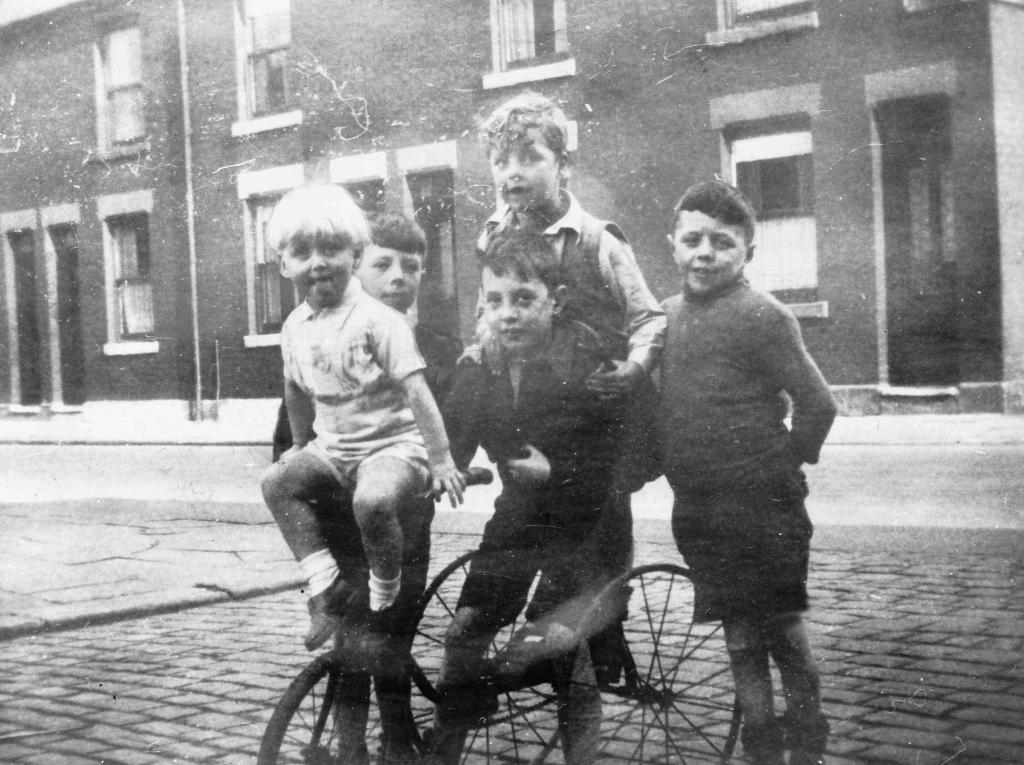
John as a small child, perched on the handlebars of a tricycle as he plays with friends in Stowell Street.
1953 – 1958: Teenage Years
With an appreciation for English, but less interest in maths and sciences, John scraped through his 11+ exam, narrowly missing a place at Grammar School, and moved on to Ducie Technical College. Two teachers here, headmaster Sam Hughes and history teacher & drama leader John Lee, recognised John’s talent and encouraged him in his ambition for acting.
In 1954, John played Mistress Quickly in the school production of King Henry the Fifth. He went on to gain significant roles in the school plays at Ducie.
John was busy soaking up inspiration during these days, delighting in film and theatre and listening to records of Laurence Olivier reciting Shakespeare, which he was able to memorise. He entertained his friends by mimicking their teachers as well as characters from popular programmes of the day such as The Goon Show. Encouraged by his teachers, John read the classics from local library books, and also began reading modern playwrights and following theatre news. The dream of becoming an actor was starting to grow.
When he was fourteen, John was given the role of compere, or ‘Master of Ceremonies’, for the Burnage Community Association concert party. Despite seeming shy offstage, John’s star quality showed as he drew on the material he’d used at the Odeon cinema, entertaining the audience with stand-up comedy, mimicry and songs. The concert party performed yearly at Green End school and went around hospitals and town halls.
In his final year of school, John took the role of Macbeth in the school play. He was only fifteen years old, but his talent was clear to all who watched the play.
John left school at the age of fifteen and worked first as a porter at a fruit and vegetable market, then as a baker’s apprentice, disliking the unsociable hours and low pay. Thankfully, he was successful in gaining an audition for the Royal Academy of Dramatic Art (RADA). Contacts from the Burnage Community Association provided elocution and drama lessons ahead of the all-important audition. His headmaster at Ducie, Sam Hughes, had gone out of his way to help to secure a grant from Manchester Council to pay the RADA fees.
At sixteen, John was two years under the minimum age requirement for RADA, and therefore pretended to be nineteen. His speech from Shakespeare, bolstered by the elocution lessons and inspiration from his Olivier LPs, made enough of an impression that the panel saw his potential. He was offered a place.
RADA
29 September 1958
John began his first year of studies. A working-class lad from a northern background, he did not settle in easily at the Royal Academy of Dramatic Art, where it seemed that the majority of students were middle- or upper-class southerners. His Teddy boy image at the time perhaps did not help matters, appearing to unsettle his classmates, who avoided him. As well as becoming shy and withdrawn, John felt self-conscious about his background and Manchester accent, an insecurity which seemed to hold him back in his studies. Despite the struggle, he passed his first exams, and returned for a second term feeling determined.
During this time, John was befriended by fellow student Tom Courtenay, who introduced him to others from similar backgrounds. John began to settle in, and eventually shed the Teddy boy fashions along with his Manchester accent. By the end of the year, John was receiving far better reports.
His training at RADA gave John an excellent grounding in theatre, with a focus on the classics. In his first year, starting on 29 September 1958, John’s roles included Guiderius in Cymbeline, The Banished Duke in As You Like It, Lopature in The Cherry Orchard, Aune in Pillars of Society, Baptista in The Taming of the Shrew, Florizel in A Winter’s Tale, Matthew Skipps & Hebble Tyson in The Lady’s Not for Burning, Sir Andrew Aguecheek in Twelfth Night, and the title character in Macbeth.
5 October 1959
John returned for his second year at RADA. By now he was making such rapid progress that he was able to skip some exams, and he and Tom Courtenay were recognized as outstanding students. Their friendship was a source of mutual support, and the two were by now sharing a flat in Highbury Crescent. Friend and fellow student Nicol Williamson was also a frequent visitor. It was Tom Courtenay who first introduced John to classical music, feeling that it might help John with his understanding of Faust, one of their final performances at RADA. John was transfixed by the music.


Mephistopheles is played by John Thaw.
John’s second year theatre performances included the roles of Snake in The School for Scandal, Tubby in Hobson’s Choice, Mammon in Paradise Lost, Teiresias in Antigone, and Chorus in Alcestis. His impressive performance as Mephistopheles in Faust earned him a glowing review in The Stage newspaper and the Vanbrugh Award on graduation.
18 to 23 July 1960
At the end of their training, John and Tom appeared in a RADA production of The Knight of the Burning Pestle (which they jokingly referred to as The Knight of the Burning Pisspots) in Stratford-upon-Avon.
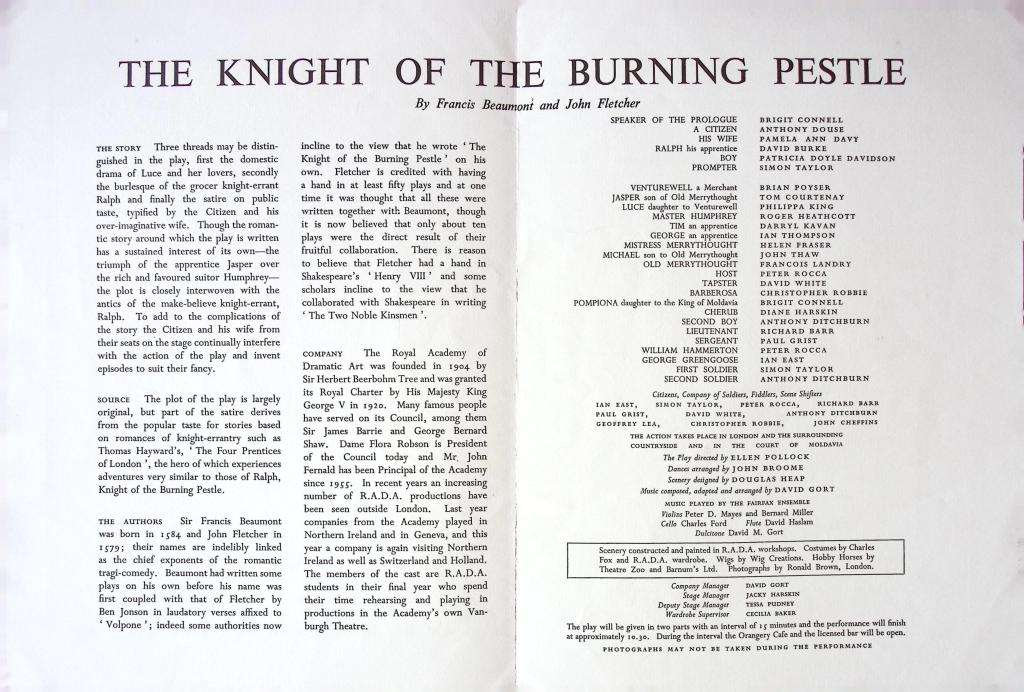
Michael … son to Old Merrythought is played by John Thaw.
July 1960
Having received outstanding reports on his final performances, John graduated from RADA with an Honours Diploma. He won the Liverpool Playhouse Prize, which provided a year’s contract with the Liverpool Repertory Company. At the age of eighteen, John had already gained his first paid contract as a professional actor.
Next page: 1960s
References:
Boardman, David. ‘Longsight Memories’. Our Manchester. Available at: https://manchesterhistory.net/LONGSIGHT/homeopen.html
Hildred, S. and Ewbank, T. (2012). John Thaw: The Biography. [Kindle]. London: Andre Deutsch.
Bibliography:
Hancock, S. (2004). The Two of Us: My Life with John Thaw. London: Bloomsbury Publishing.


 John Thaw Archive