It could be said that John Thaw was destined to become an actor. As a small child, he began entertaining his family with impressions of favourite radio personalities of the time. This emerging talent continued to grow throughout his childhood, with John performing in school plays and also for a local concert party which entertained at care homes and in town halls. Later, with the invaluable support of friends, teachers, and his family, John was successful in auditioning for a place at the Royal Academy of Dramatic Art, and in securing a financial grant, without which his family would have been unable to afford the fees. He went on to have a successful career in television, film and theatre, becoming one of Britain’s best loved actors.
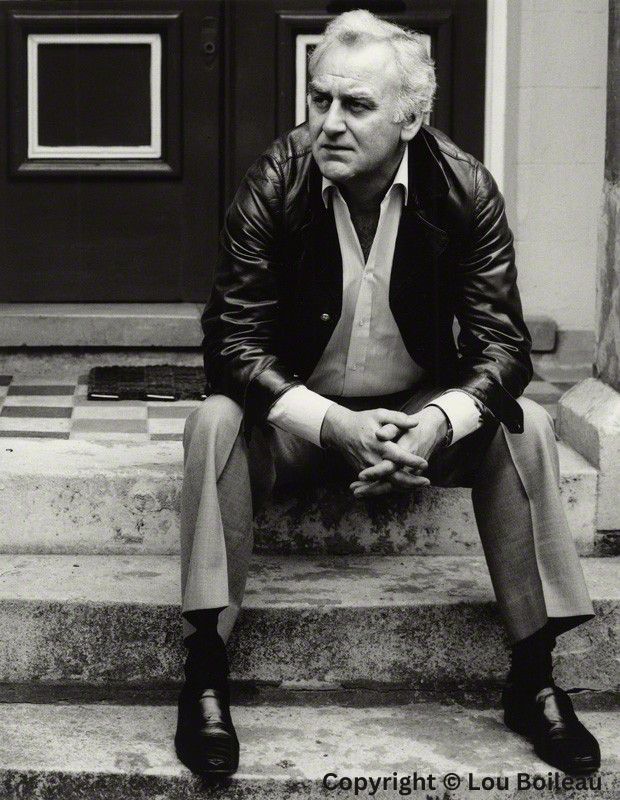
John was born on 3 January 1942, to working-class parents John “Jack” Thaw and Dorothy Ablott. The family lived for the first few years of John’s childhood in the inner-city suburb of West Gorton, and later moved to the Kingsway Housing Estate on Daneholme Road in Burnage. Sadly, his mother moved out of the family home when John was only seven years old and his brother, Ray, was five. The boys were brought up by their father, with the support of friends and neighbours. John was known and respected in Burnage by his peers, despite his interest in drama and literature, and lack of inclination for sports!
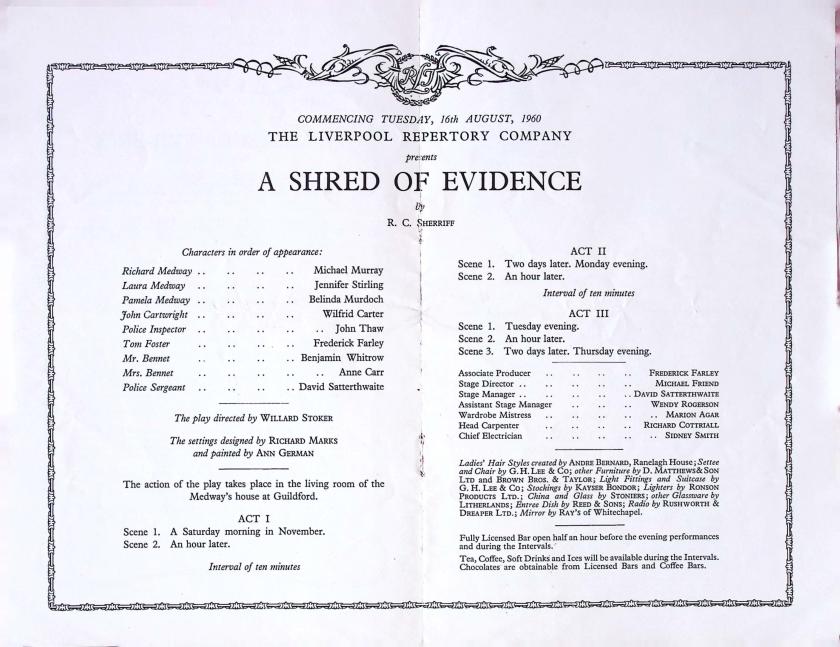
John began his studies at RADA in 1958, when he was only sixteen years old. Although reportedly shy and withdrawn, and initially struggling to settle in, he began to excel in his training, and was gaining excellent reports by his second year. He graduated in 1960 and went straight into a season with the Liverpool Repertory Company, making his stage debut in the play A Shred of Evidence. Rather appropriately given certain future TV roles, John played the Police Inspector!
See the programme for evidence (!) …
Further theatre work followed, including a role in Semi-Detached with Laurence Olivier. In this, he also understudied Olivier’s leading role, which he was called on to perform .
John Thaw began his television career with a series of plays called The Younger Generation, filmed by Granada Television to showcase the talents of up-and-coming young actors. After guest roles on Z-Cars and The Avengers, he gained his first leading role as Sergeant John Mann in the series Redcap (1964 to 1966).
John as Sergeant Mann in Redcap.
The success of this series began to make him a household name in the UK. He also appeared in two Edgar Wallace Mystery Theatre films, Five to One (1963) and Dead Man’s Chest (1965).
In June 1964, John married Sally Alexander, who had worked as Assistant Stage Manager during the run of Semi-Detached. Sally gave birth to their daughter, Abigail, in October 1965.
John went on to gain further television roles, starring in the Francis Durbridge TV series Bat out of Hell (1966) and in the Granada series Inheritance (1967). In 1968, he co-starred in the film The Bofors Gun. He also continued to work in the theatre.
In 1969, John appeared in the stage play So What About Love?, playing opposite actor Sheila Hancock. By now divorced, John fell in love with Sheila and eventually declared his feelings to her. “I just wanted you to know, that’s all”, Sheila Hancock remembers him saying. (Hancock, 2004, p. 144). She was, however, happily married to actor Alec Ross. It was not until after Alec’s death from cancer in 1971 that John and Sheila began seeing each other. The romance blossomed quickly and the couple married in December 1973, with the blessing of John’s daughter, Abigail, and Sheila’s daughter, Melanie, whom John later adopted. John and Sheila’s youngest daughter, Joanna, was born in July 1974.
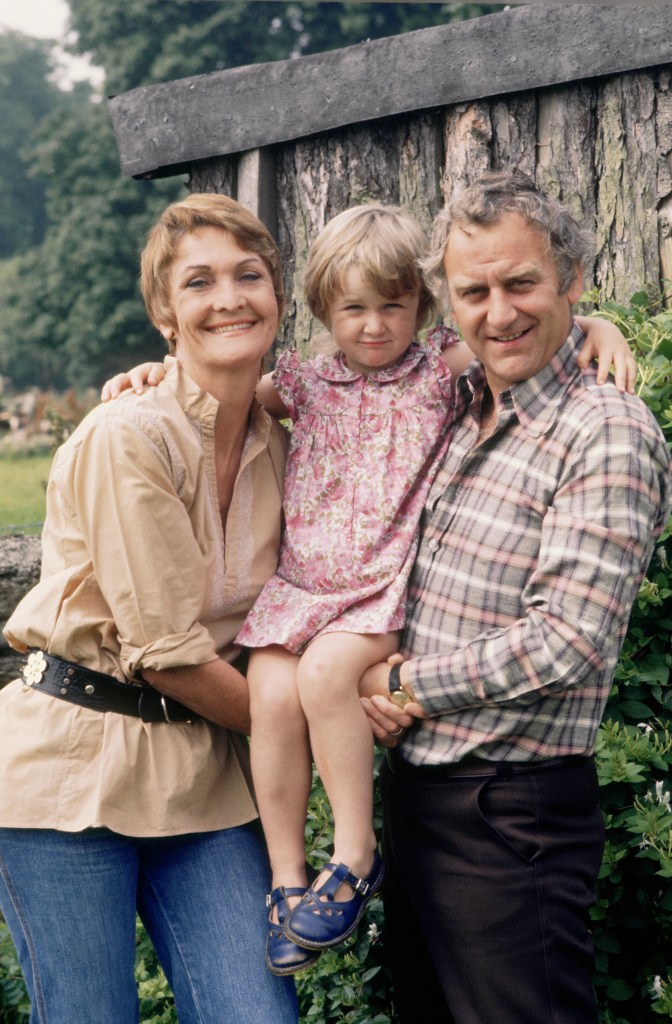
John’s television career grew steadily during the early 1970s, with a broad range of roles in TV anthology series and plays, guest appearances on series’ such as Budgie, and a co-starring role in the comedy series Thick as Thieves (1974) opposite Bob Hoskins and Pat Ashton. He took the title role in the TV play The Sensible Action of Lieutenant Holst (The Rivals of Sherlock Holmes) in 1973, and starred in the vastly different role of Tom in the modern drama series The Capone Investment (1974).
At the age of only thirty-two, John gained the role of Detective Inspector Jack Regan in the Armchair Theatre TV film Regan (1974). This one-off play led to the creation of the series The Sweeney, which ran for four series from 1975 to 1978, plus two feature films. It is one of the roles for which John is best remembered. The popularity of the series established him as a major, well-known television actor. John was somewhat uncomfortable with the attention resulting from this fame, although he greatly enjoyed appearing with Eric and Ernie in the 1976 Morecambe and Wise Christmas show! The friendship between himself and co-star Dennis Waterman, and their camaraderie with the regular cast and crew, was also much enjoyed.
A variety of film and television work followed The Sweeney. John starred as Sir Francis Drake in TV film Drake’s Venture (1980), and spent time filming in Africa for The Grass is Singing (1981). He also travelled to Belfast to film the thought-provoking TV film, We’ll Support You Evermore (1985). He disliked being away from home, and found that this emotional play affected him deeply. He was nominated for a BAFTA for his supporting role in the Richard Attenborough film Cry Freedom (1987).
John also continued his theatre career throughout the 1970s and 1980s. Roles included Sidney in the first major UK tour of Alan Ayckbourn’s Absurd Person Singular and Dick Wagner in a lengthy run of Tom Stoppard’s Night and Day.
He also travelled to Australia with Sheila, the pair appearing together in Michael Frayn’s play The Two of Us. He worked with The National Theatre in 1981, in the title role of Serjeant Musgrave’s Dance.
John went on to complete a season with the Royal Shakespeare Company from 1983 to 1984, appearing in The Time of Your Life, Twelfth Night and Henry VIII. He worked with the Theatre of Comedy in a production of Pygmalion, playing Alfred Doolittle alongside Peter O’Toole as Higgins. He performed in Ray Cooney’s farce Two Into One in both London and Toronto.
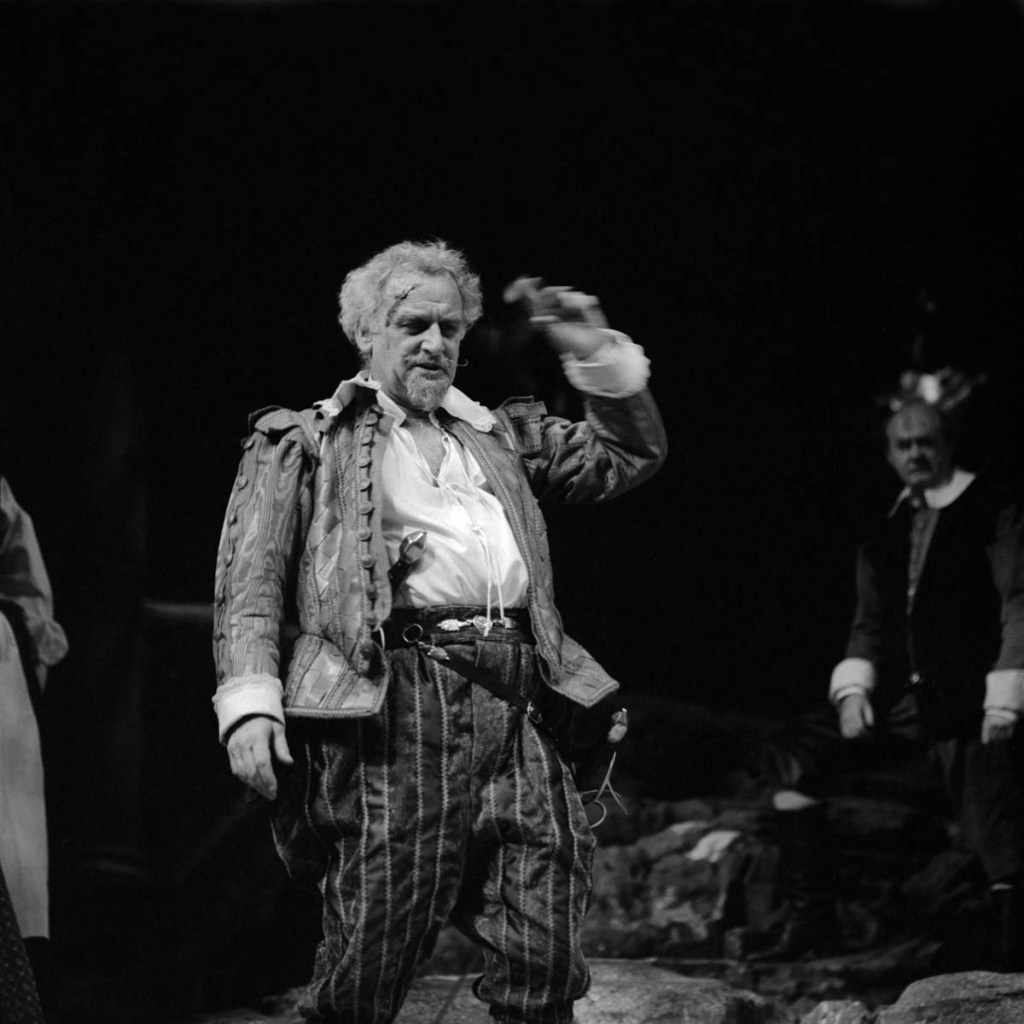
By Joe Cocks Studio, ©The Shakespeare Birthplace Trust, CC-BY-NC-ND 4.0
Used under a Creative Commons CC-BY-NC-ND 4.0 license
https://collections.shakespeare.org.uk/about/using-images-from-our-collection
Another departure from serious film and television roles was the sitcom Home to Roost (1985 – 1990), which starred John as the divorced middle-aged father of teenager Reece Dinsdale.
John Thaw was forty-four when filming started in 1986 for the first episode of Inspector Morse, although it is often noted that he looked older. He was perfectly cast as the grumpy-yet-vulnerable Detective Chief Inspector Morse, making the character completely his own. Along with the role of The Sweeney’s Jack Regan, Inspector Morse is undoubtedly the role for which John is best remembered, and for which he is known around the world. He received several BAFTA awards and nominations for the series.
The hugely popular series ran for seven series plus a number of special episodes, the last of which, “The Remorseful Day”, was shown in November 2000. Viewers were moved to tears by the death of Morse, particularly at the moment when his loyal sergeant Lewis says his final goodbye to the deceased Morse. It is a testament to the acting skills of John Thaw and his co-star and friend Kevin Whately that the characters of Morse and Lewis had become so real in the hearts and minds of the audience.
Not one to risk becoming stagnant in his career, John continued to take on many other varied roles in between filming episodes of Inspector Morse, including TV films Bomber Harris (1989), Into the Blue (1997) and The Waiting Time (1999). One of his best-loved performances was that of the stoic-yet-kindly Tom Oakley in the TV film Goodnight Mister Tom (1998), for which he received awards from BAFTA, the National Television Awards and the TV Quick Awards. He also appeared once more on the big screen in Richard Attenborough’s film Chaplin (1992). As Inspector Morse drew to a close, John started a new venture, the series Monsignor Renard, set in occupied France during WWII. On stage, John starred in David Hare’s The Absence of War, performed at the National Theatre in 1993 and which was also filmed for the BBC in 1995.
In 1993, John Thaw was was awarded the CBE (Commander of the Order of the British Empire) in the Queen’s New Year Honours List.
Another TV series for which John is well-remembered is Kavanagh Q.C. (1995-2001). Principled barrister James Kavanagh reflects a working-class, northern background not dissimilar to John’s own. As with all his roles, John inhabits the character of Kavanagh, creating a figure with whom viewers can empathise.
His final television role was in the heart-warming TV film Buried Treasure (2001), playing a career-centred man who finds room in his heart for the grandchild he hadn’t known he had.
John performed for the final time in a BBC Radio 3 production of Peter Pan, recorded in front of a live audience in April 2001 to be broadcast on the radio on New Year’s Eve. With wife Sheila Hancock as the narrator, John played Captain Hook. It was the first time he had performed in a musical, and he demonstrated a fine singing voice. The performance was a splendid success.
John was diagnosed with cancer of the oesophagus in June 2001. He underwent treatment, and was determined to recover and return to work. He had signed a renewed contract with Carlton Television the day before he died.
John Thaw died on 21 February 2002 at his beloved country home in Luckington, Wiltshire, surrounded by his family.
Read a more detailed account of John’s life and career.
References:
Hancock, S. (2004). The Two of Us: My Life with John Thaw. London: Bloomsbury Publishing.
Bibliography:
Fairclough, R. and Kenwood, M. (2002). Sweeney! The Official Companion. London: Reynolds & Hearn Ltd.
Hildred, S. and Ewbank, T. (2012). John Thaw: The Biography. [Kindle]. London: Andre Deutsch.
IMDb contributors (2023). ‘John Thaw’. IMDb. Available at: https://www.imdb.com/name/nm0857177/
The ITV programme, The John Thaw Story (2002)


 John Thaw Archive